Know
your eggplants
To those of us living with plants it is always a
source of
amazement that eggplants are so little known. Asian and African
consumers know
theirs well but are less familiar with the Asian or Western types.
Westerners
are equally ignorant of the richness found in Asia and
This is understandable because apart from the large purple
fruit that everyone knows, very little else is seen in market stalls or
on the
supermarket shelves. This is not confined to eggplants, it applies to
every
crop grown and distributed via the market place which, despite the
"global
village" and the "global market" concepts, remains a market of
rather narrow minded traders and consumers. This may be enough to meet
the
needs of the best known recipes of the
Western world such as the Greek “moussaka”, the
Middle Eastern “baba ghanoush” and “imam
bayaldi”, the French “ratatouille”, and the
Sicilian “caponata”. But
what if one wants to cook “nkwi” or "แกงไทย"
(Thai
curry)?
Some seed companies go to great lengths to make available to
their customers a wide range of cultivars (cultivated varieties), but
unless
people grow the plants, they are not likely to come across some of the
most
beautiful eggplants available on this planet.
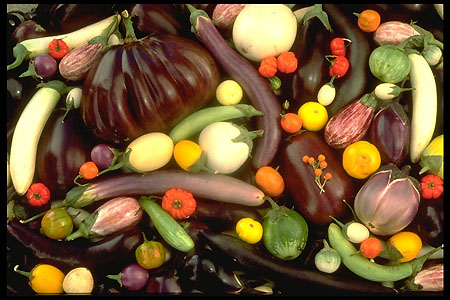
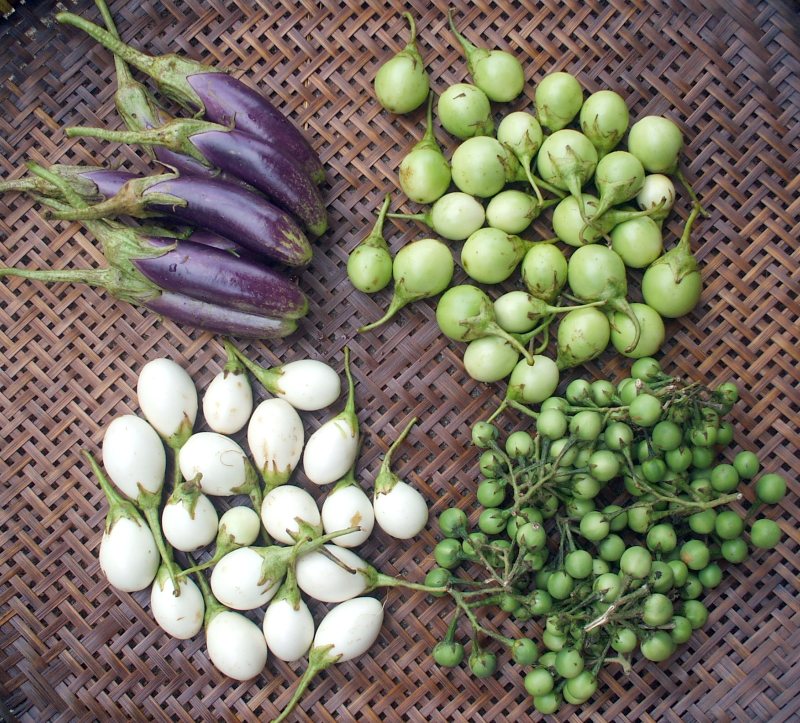
This brilliant display encompasses most of the
shapes and
colours (but not all) available in the world. The species and mostly
the
cultivar names will vary greatly in the market place but the basic
array will
be found. These fruits from open-pollinated varieties were all grown by
David
during his gardening days with the Seed Savers Exchange
The main difference between the western types of eggplants
and the African or Asian is that the first are well and truly
domesticated,
some would argue too much manipulated and hybridised if not yet
genetically
manipulated. The Asian and African eggplants are much less domesticated
for the
most part and are either close to their wild relatives or just plain
wild
plants such as the pea eggplant from
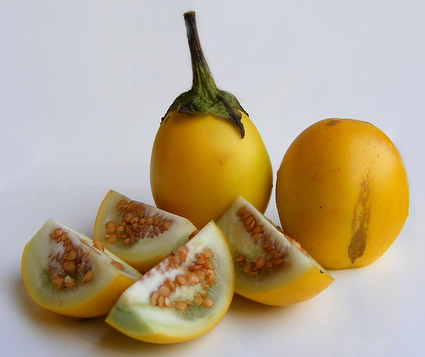
The best known African eggplants are the miniature
pumpkin-shaped so called "African
scarlet eggplant" and the Brazilian Jiló.
They both, together with other groups, come under the
domesticated species Solanum aethiopicum
L., a species with a rich history. The ancestor of this species was the
wild Solanum anguivi Lam. Natural evolution
and people influences helping, via the semi-domesticated Solanum
distichum Schumach & Thonn. found in gardens of
Tropical Africa, Solanum aethiopicum
L. was born. Following
further adaptation to different conditions and responding to various
cultural
practices, such as selection for leaves as opposed to selection for
fruits, the many groups were formed. One
group has found its way to

This image was originally posted to Flickr
by Brocco Lee at http://flickr.com/photos/69772513@N00/1464988775.
It was reviewed on 00:45, 4 October 2007 (UTC) by the FlickreviewR
robot and confirmed to be licensed under the terms of the cc-by-sa-2.0.
'Brazilian Oval
Orange', 'Jilo Tingua
Verde Claro' (both from Baker Creek Heirloom Seeds), and 'Comprido Verde Claro' are all
suitable
for Brazilian cuisine. Some
similar looking cultivars such as "Striped
Tioga" are listed under Solanum melongena L. in various
catalogues. ‘Sodefel’
is a cultivar from the Ivory Coast.
Solanum aethiopicum
L. (Kumba Group)

Reproduced with permission from the copyright owner:
Veronica Sullivan
Plants of this group can be found in
catalogues under the synonym "Orange African eggplant". It is often
treated as an ornamental in the West because it is strikingly beautiful
but
also because from a culinary perspective it does not meet the taste of
every westerner. Much of the negative feelings towards it are based on
ignorance of
the basic preparation. The fruits are
best picked green, before they start colouring and developing seeds - a
general
rule applying to all eggplants.
According to the trade there are some sweet cultivars such
as 'Red Ruffles' and some bitter
cultivars such as 'Turkish
Some edible cultivars are grown for their leaves 'Gbogname' may be one of them (see below),
others for their fruits such as 'Red
Ruffled' aka 'Hmong Red', 'Red China' aka 'Scarlet Chinese', 'Turkish
Orange' , 'Goyo Kumba' and yet
others for both.
Unlike the pretty fruits in the photo above many
edible African eggplants are not so attractive and look more like the
fruits below:
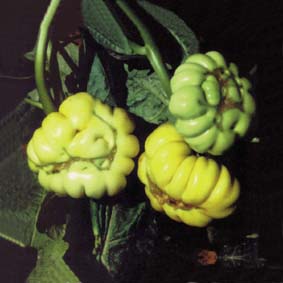
Photo credits Technisem Seeds.
(permission sought 20/04/2009)
Some popular African cultivars selected and grown for their fruits are:
'Soxna' ( Senegal - no detail
on hand), ‘Dwomo’
(Ghana
- egg type of fruit) ‘Ndrowa’
(non bitter yellowish- green fruits), ‘Ngalam’ (slightly bitter green to
white
fruits), 'Ngoyo' (bitter
dark-green fruits),
‘Jaxatu Soxna’ (bitter
pale-green to white fruits). These may be
available from the sources mentioned in the table below or The African
Seed Trade Association.
Solanum aethiopicum L. (Shum Group)
The cultivars within
this group
are grown for their leaves. The little bite-size fruits although edible
when
ripe are often neglected. The cultivar 'Gbogname' may belong to this group.
This is a group of plants with
fruits twice as large as those of the Shum type but totally
neglected from the culinary
point of view. One wonders if their spiny leaves and stems are a
consequence of
the neglect or the cause of it. They can be grown as ornamentals or
used as
root stock for tomatoes and eggplants. ‘Iizuka’
has
been selected in Japan
for this purpose.
Solanum anguivi
Lam.
<
http://database.prota.org/dbtw-wpd/protabase/Photfile%20Images%5CSolanum%20anguivi%20178b%20RRS.jpg
>.
Photo credits R. R. Schippers
(permission sought 20/04/2009)
As a semi-domesticated
species it
offers a great variation in the plants, flowers and fruits numbers,
sizes,
colours etc. Worth noting is the Ouganda Pea eggplant. The bitter
pea-size
green fruits are eaten in various ways fresh or dried. In
'Damsah' .
Photo credits ECPGR.
(permission sought 20/04/2009)
Propagation
of the African
eggplants.
From the seed saver perspective the first thing to keep in mind is that these plants are tropical. The second is that all the plants from all species named above can cross with each other, produce fertile seeds and therefore in the right conditions can become weeds. Similarly in non-tropical settings it will be equally important to avoid cross-pollination by isolating in the usual manners: distance, netting, bagging, spaced flowering if possible etc. This is not to avoid propagating weeds but to conserve cultivars true to type as much as possible.
Solanum
macrocarpon L.

This is also known as the "African eggplant". A better hybridised name is "Gboma eggplant" based on its correct African name Gboma. One could say of this species also that it is semi-domesticated. As such it still has great variations in its growth habit, fruit sizes etc. It is one of the semi-wild species showing the greatest potential for hybridising. The main reason is that its great diversity could be developed in many directions. The second is that its natural resistance to bugs and diseases could improve weaker varieties of the main domesticated species Solanum aethiopicum L. and mostly Solanum melongena L.
When cultivated, varieties are selected for their
fruits,
usually the thin skinned are preferred, or their leaves. Both fruits
and leaves
are bitter and most need to be consumed locally. This can only be an
advantage
from the ecological viewpoint - no storage - no transport to the other
side of
the world. If the rest of the world wants it, it has to grow it or does
it?
Despite the ordinary quality of the crop some enterprising countries
have
managed to develop some thick-skinned fruits that will store and
travel.
|
Botanical identification |
Cultivar name / Vernacular name |
Descriptive info |
Photo if available |
|
Solanum aethiopicum L. (Gilo Group) |
'Comprido
Cachoeira ' |
Elongated
fruits vary from 20 to 50g per fruit. |
|
| Solanum aethiopicum L. (Gilo Group) |
'Tinguá' aka 'Tingua Verde Claro' aka ' Jiló Tinguá Verde Claro' | Plant
is heavy yielder. Fruits consumed green, mature to orange and red. From
Minas Gerais, Rio de Janeiro Available : Baker Creek Heirloom Seeds, Kokopelli |
|
| Solanum aethiopicum L. (Gilo Group) | 'Morro Grande Verde-Escuro' aka 'Dark
Green Morro Grande' |
Dark-green larger round or
oblong fruits 6 - 7
cm
diameter, 80 - 100 g . From São Paulo. Available : ISLA, SAKATA Seed Sudamerica Ltda. |
|
| Solanum aethiopicum L. (Gilo Group) | 'Morro Rodondo' | Bitter round dark-green fruits about
1/4 of
the size of a medium size eggplant. From São Paulo. Available : Possibly from Johnny's Selected Seeds. |
 Copyrights Maria Moreira |
| Solanum aethiopicum L. (Gilo Group) | 'Comprido verde claro ' aka ' Comridio verde ' (misspelt) | Tear-drop light green fruit about 1/4
of the
size of a medium size eggplant. From Minas Gerais,
Rio de Janeiro & Espirito Santo. Available : Possibly from Johnny's Selected Seeds. |
|
| Solanum aethiopicum L. (Gilo Group) | 'Comprido Grande Rio ' | 8 -10 cm thick fruits 80 - 100 g.
Elongated
form of Verde Claro from Minas Gerais,
Rio de Janeiro. Available : SAKATA Seed Sudamerica Ltda. |
|
| Solanum aethiopicum L. (Gilo Group) |
'Português' |
8 -10 cm thick fruits 80 - 100 g.
From Minas
Gerais,
Rio de Janeiro. Available : SAKATA Seed Sudamerica Ltda. |
Similar to 'Comprido Verde Claro' |
| Solanum aethiopicum L. (Gilo Group) | ‘Sweet African Egg’ aka 'Sweet African Orange' | 4 inches
(10 cm)
oval or round fruits maturing from white to shiny orange-red. 90 days
2.5' on plants 2.5 feet (76 cm) tall. Available : Terroir Seeds LLC. |
|
| Solanum aethiopicum L. (? Group) | ‘Turkish Orange’ aka 'Italian Orange' Probably not a true synonym | Orange
spherical fruits, 6 cm in diameter to tennis-ball size (2.5 to 3 inches). "Excellent
sweet taste" to "Bitter taste" depending on picking time. 80 days to 90
days. 4 foot plants bear 15-25
fruits per plant. Available : Reimer Seeds, Baker Creek Heirloom Seeds, Seeds of Change, Chiltern Seeds, Southern Exposure Seed Exchange, Diggers Seeds Aust., Kokopelli. |
|
| Solanum aethiopicum L. (? Group) | ‘Sweet Red’ aka 'Sweet Orange' | small,
attractive fruits, about 2.5 cm in diameter, with the green skin with
dark-green stripes, turning red with dark-red stripes at maturity, Available : no known source. |
Seems to have disappeared. We could no longer find it on the market. |
| Solanum aethiopicum L. (Kumba Group) | ‘Small Ruffled Red’ | small,
deeply creased fruits, about 5 cm in diameter, with orange-red skin, 2" fruits are borne in clusters on 20" plants.
Fruits are bitter, but used extensively in Asian cuisine. Available : Seed Savers Exchange. |
|
| Solanum aethiopicum L. (? Group) | 'Melanzana Rossa di Rotonda' aka 'Merlingiana a Pummadora' aka 'Italian Orange' | Brought
from
Africa and grown since the late1800's in Rotonda - Italy and claimed with justification as
an Italian Heirloom. Available : Italian private growers. |
|
| Solanum
macrocarpon L. (Mukono Group) |
‘Mukono’ |
|
|
| Solanum
macrocarpon L. (Nabingo Group) |
‘Nabingo’ |
|
|
| Solanum
macrocarpon L. (Uganda Group) |
‘Uganda Pea’ |
Tiny
pea size white to green fruits. |
|
| Solanum aethiopicum L. (? Group) |
‘Manyire
Green’ |
Round, green ripening to red fruits. From East Africa. |
|
| Solanum aethiopicum L. (? Group) |
‘Tengeru
White’ |
Round, half green, half white fruits. |
|
| Solanum aethiopicum L. (Kumba Group) |
‘Jaxatu
Soxna’ |
Light
green
to white, 50-80 g, from Senegal. Available : possibly Technisem |
|
| Solanum aethiopicum L. (Kumba Group) |
‘N’Goyo’ |
Bitter
dark-green fruits, variable in size according to conditions. 70-120 g.
60 80 days. Available : Technisem, Graines Baumaux |
|
| Solanum aethiopicum L. (Kumba Group) |
‘N’Galam’ |
Slightly
bitter Light-green to white fruits, variable in size according to
conditions.120-180 g. 65 - 75 days. Available : Technisem |
|
| Solanum aethiopicum L. (Gilo Group) |
‘Sodefel’
|
A
cultivar
from the Ivory Coast. |
|
| Solanum aethiopicum L. (Gilo Group) |
'Brazilian Oval
Orange' |
Available
: Baker
Creek Heirloom Seeds |
|
| Solanum aethiopicum L. (Kumba Group) |
'Red
Ruffled' aka 'Hmong Red' |
|
|
| Solanum aethiopicum L. (Kumba Group) |
'Goyo Kumba' |
Available
: Kokopelli |
|
| Solanum aethiopicum L. (Kumba Group) |
'Red China' aka 'Scarlet Chinese' |
Available : Baker Creek Heirloom Seeds (seeds), Cross Country Nurseries (seedlings) |
|
| Solanum aethiopicum L. (? Group) |
'Red Skin' |
Available
: Eden
Seeds |
|
| Solanum aethiopicum L. (Kumba Group) |
'Gbogname' |
A
variety
grown for its leaves. |
|
| Solanum aethiopicum L. (Kumba Group) |
‘N’Drowa’ |
Non
bitter
yellowish- green slightly ribbed fruits on very vigorous plants. 55 -
60 days. Available : Technisem |
|
| Solanum aethiopicum L. (Kumba Group) |
‘Dwomo’ |
Egg-shaped
fruits. From Ghana. |
|
| Solanum aethiopicum L. (Kumba Group) |
‘Super N'Drowa’ |
Sweet
ivory-white round fruits on very vigorous plants. 55 - 60 days. Available : Technisem |
|
| Solanum aethiopicum L. (Gilo Group) |
‘Red Egg’ |
Available
: Graines
Baumaux |
|
| Solanum aethiopicum L. (Kumba Group) |
‘N’Drowa Issia’ |
Sweet
fruits
5 cm diameter 70 - 80 g. From Ivory Coast. Available : Graines Baumaux |
|
Reproduced with permission from the copyright owner: Dorami Chan
Asian eggplants have representatives in these better known species: Solanum melongena L. , Solanum torvum Sw. , Solanum ferox L. Other mostly wild species are used both as sources of food and medicinal plants.
Solanum
melongena L.
There is an abundance of cultivars of all sizes,
shapes and colours among the Asian eggplants, far greater than among
Western
types. Here are a few examples to make your salivate:
Green semi-long eggplant
< http://www.flickr.com/photos/garandee/3394068255/
>.
garandee
Solanum torvum Sw.
Curiously this Central
/ South
American species, common garden plant in the Caribbean, is better
known in Asia and here in Australia is always
referred to as an Asian vegetable or "Thai pea
eggplant". This is due to the
efforts of the Thai horticultural community which has developed and
promoted
locally as well as abroad some improved cultivars. Elsewhere it tends
to be
considered as a weed even as a noxious weed due to its ability to self
seed. In
marketing terms, in some parts of
Generally speaking clusters of
immature green fruits rather than individual fruits are
picked when they reach pea- size or cherry- size, depending on
cultivars. Some
catalogues offer varieties without prickles, some sweet-fruited
cultivars and
seeds for rootstock production.
One probably would have to look through the hybrids
for really improved large and / or sweet fruits and for prickles
plants.

Reproduced with permission from the copyright owner: Dorami Chan
Pingpong F1
Photo credits: East-West Seed International
There is a "cultivar" in Togo called
'Gboma' but this being the
common African name for many eggplant types it is
really misleading.
Solanum
ferox L.
Solanum ferox L. (Sinkade Group)
This group seems to be composed mainly of plants from Burma (now
called Myanmar). As
one would expect there is a cultivar called 'Sinkade' with larger cherry-sized
fruits.
Some of the widest ranges of Asian eggplants are to be found in the following galleries:
Evergreen Seeds' site < http://www.evergreenseeds.com/oreg.html >
Cross Country Nurseries (seedlings) < http://www.chileplants.com/search.asp?CategoryID=7&ImageHeader=eggplants&SearchButton=Go >. Among their Asian eggplants is a cultivar called 'Red China' (listed as Solanum melongena L.) looking very much like the African 'Kumba'.
Baker Creek Heirloom
Seeds <
http://rareseeds.com/seeds/Eggplant
>. 'Red China' is also listed here.
Appendixes
Among
the millions of photos that could not make it in this article here is a
list of URL for you to drool over on sleepless night.
Red, white-striped fruit by Overthemoon.
< http://www.flickr.com/photos/overthemoon/3013383898/
>.
Purple, white-striped by Louise design
< http://www.flickr.com/photos/louisedesign/1145364773/
>
A nice combination entitled "Symphony in Purple" by CVerwaal
< http://www.flickr.com/photos/cverwaal/1075931477/
>.
References:
Agnieszka
Sękara,
Stanisław Cebula, Edward Kunicki, 2007, Cultivated eggplants
– origin, breeding objectives and genetic resources, a review. FOLIA
HORTICULTURAE Ann. 19/1, 2007,
97-114. Department of Vegetable Crops Agricultural University
in Kraków, Poland. < http://www.ptno.ogr.ar.krakow.pl/Pobrania/download.php?action=save&id=197&
cat=fh19012007 >. PDF file. *****
Seeds /
Plants sources / Useful contacts